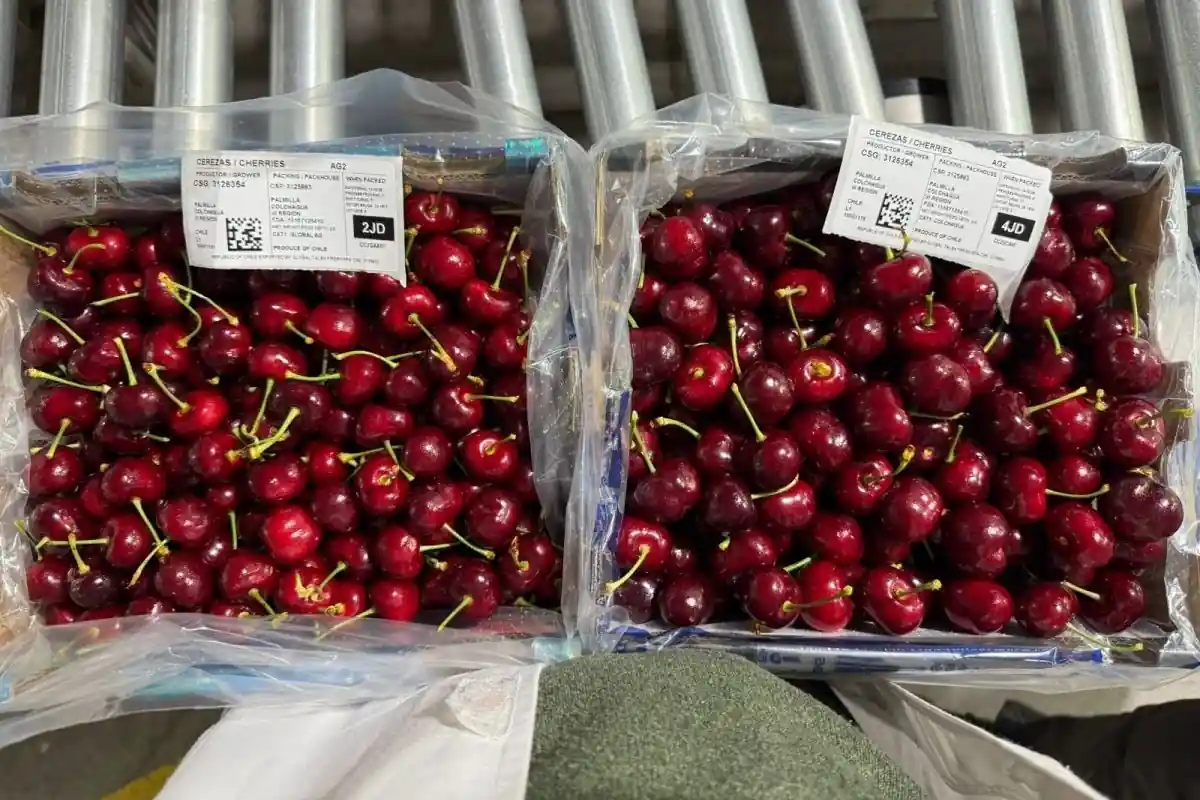
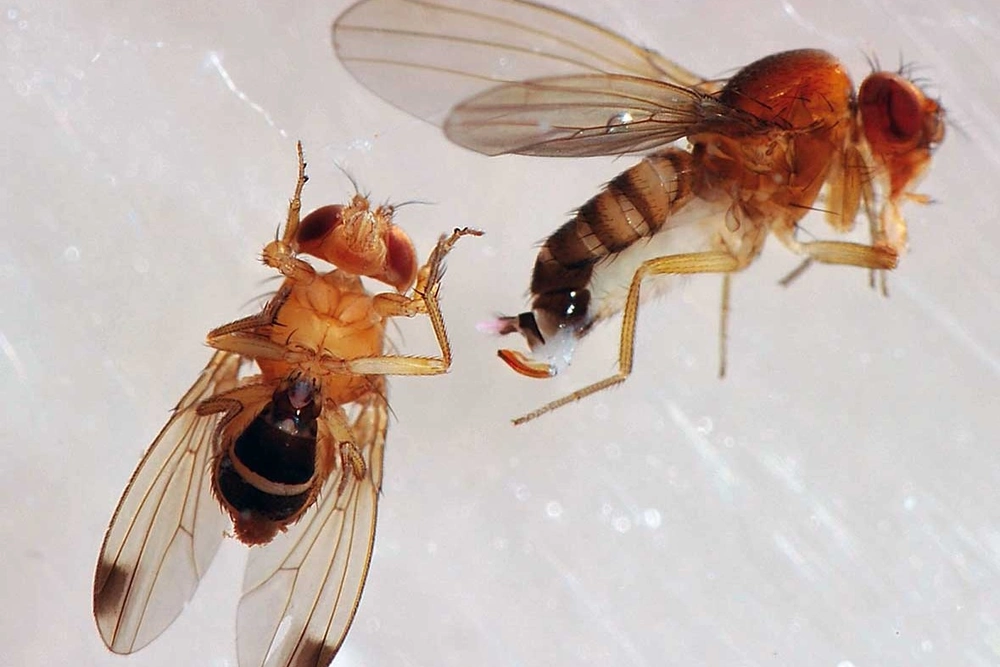
The sustainable management of Drosophila suzukii, one of the most damaging pests in fruit crops, represents a major challenge, particularly in light of increasing restrictions on insecticide use.
In this context, the sterile insect technique (SIT) is emerging as a promising strategy within integrated pest management, based on the mass release of sterilized individuals to reduce the reproductive potential of natural populations.
Traditionally, SIT relies on the exclusive release of sterile males, as only their mating with fertile females leads to a direct reduction in offspring. However, the need for sex separation entails significant technical and economic costs.
Experimental comparison of releases
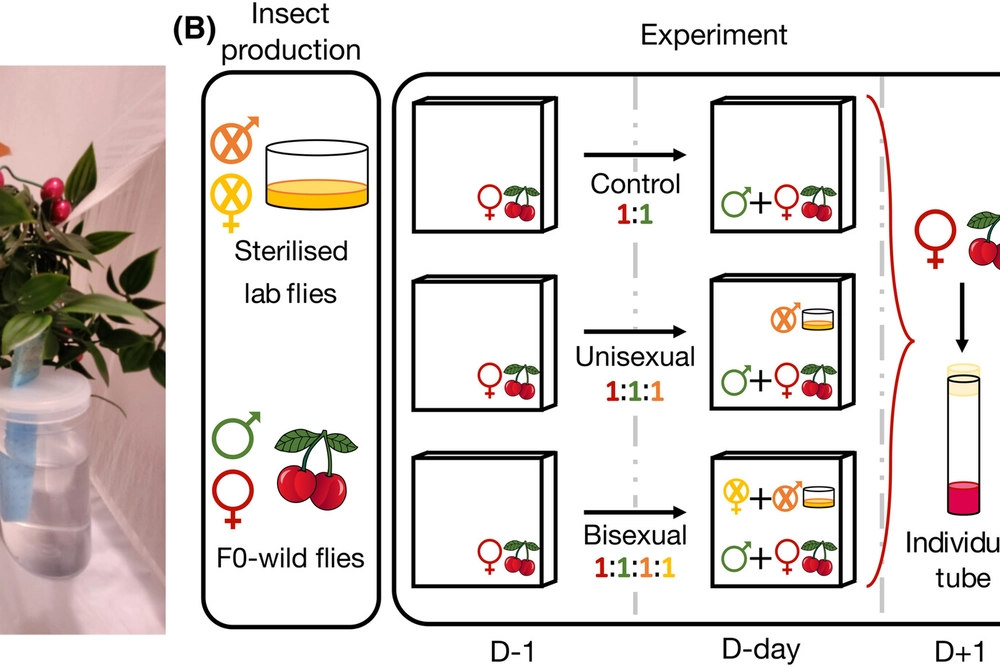
Making the evaluation of bisexual releases highly relevant. A recent study experimentally compared, under controlled yet realistic conditions, the effectiveness of unisexual and bisexual releases in reducing the fertility of D. suzukii populations under controlled conditions.
The experiment was conducted in replicated cages using first-generation wild individuals emerging from infested cherries, along with a laboratory strain for the production of sterile insects, irradiated with X-rays at a dose capable of ensuring near-complete sterility.
Environmental and behavioral conditions were designed to closely mimic natural settings, including artificial vegetation, oviposition substrates, and realistic light–dark cycles.
Results and biological implications
The results showed that the proportion of fertile females producing offspring did not significantly differ between unisexual and bisexual treatments, reaching approximately 46% and 45% respectively, compared to a much higher value in the control (84%).
Even when considering only mated females, no differences between the two strategies were observed, indicating that the presence of sterile females does not interfere with the ability of sterile males to compete with wild males.
Similarly, female mating rates were not significantly affected by the type of release, suggesting that potentially negative behavioral phenomena do not play a major role under the tested conditions.
Applications and operational limits
From an applied perspective, these findings challenge a long-standing assumption in SIT programs, namely the necessity of sex separation prior to release. In the absence of negative effects on efficacy, eliminating this step could greatly simplify production processes.
Reducing costs and improving the scalability of the technique, particularly in confined systems such as greenhouses and tunnels. However, the researchers emphasize that extrapolation to open-field conditions should be approached with caution.
As more complex ecological factors, such as canopy structure, spatial distribution of insects, and microclimatic gradients, may influence mating dynamics.
Risk assessment and agronomic impact
Another important aspect concerns the potential risks associated with the presence of sterile females, particularly in terms of direct fruit damage risk. Available evidence suggests that sterilized females do not oviposit and do not cause significant damage.
Thereby reducing concerns about the agronomic acceptability of bisexual releases and supporting their practical implementation.
Conclusions and future outlook
In conclusion, the study provides strong evidence supporting the equivalence between unisexual and bisexual releases in SIT applied to Drosophila suzukii in pest management.
Indicating that sex separation may not be necessary, at least in confined production systems. This finding reinforces the potential of SIT as a sustainable tool for the protection of cherry orchards and fruit crops more broadly.
Source: Labbetoul, A., & Fellous, S. (2026). Bisexual releases are as effective as male‐only releases to control Drosophila suzukii with the sterile insect technique. Pest Management Science, 82: 4536-4543. https://doi.org/10.1002/ps.70569
Opening image source: Il Nord Est
Internal image source: Labbe Toul e Fellous, 2026
Andrea Giovannini
PhD in Agricultural, Environmental and Food Science and Technology - Arboriculture and Fruitculture, University of Bologna, IT
Cherry Times - All rights reserved