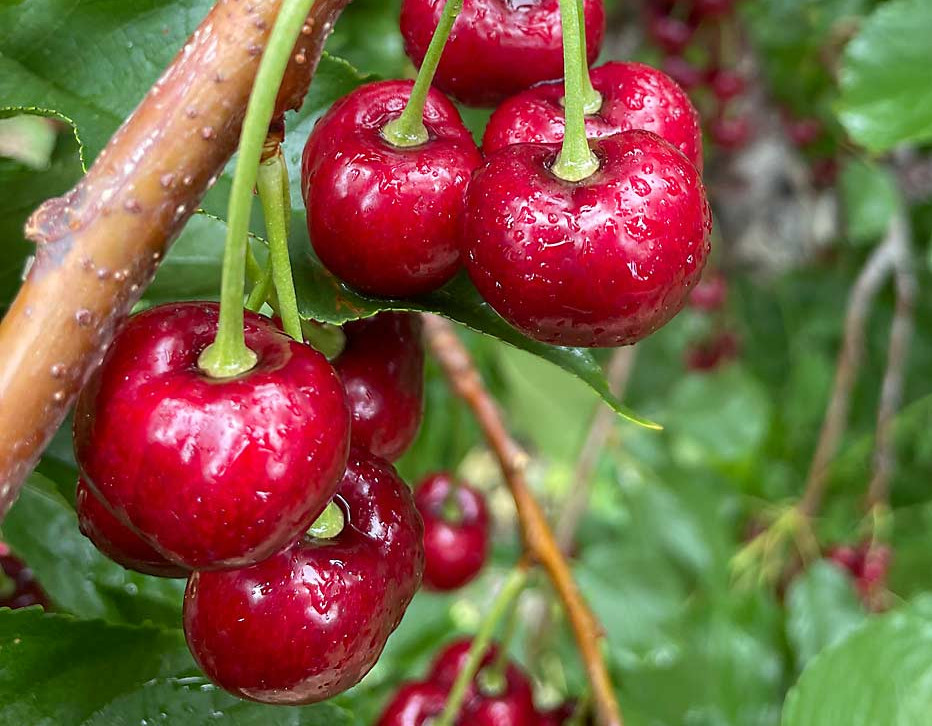
The composition of bioactive compounds in sour cherry is strongly influenced by the conditions of the growing season and, at least under the conditions considered, the effect of the growing year is more relevant than that of cultivar and cultivation system.
This is one of the main findings of a study conducted in Hungary on two sour cherry cultivars, ‘Cigánymeggy’ and ‘Oblacsinszka’, grown under both organic and conventional systems and monitored at four stages during ripening over two consecutive growing seasons.
The study examined total polyphenol, flavonoid, and anthocyanin contents, as well as antioxidant capacity determined using DPPH and FRAP assays.
Analysis
Statistical analysis showed that the growing year was the factor with the strongest influence: with the exception of DPPH, the effect of growing year was significant for all parameters analyzed, whereas cultivar affected only FRAP values and the cultivation method showed a significant effect mainly on anthocyanin content.
Polyphenol, flavonoid, and anthocyanin levels showed different fluctuations among samples and growing years, indicating that the mere progression of fruit coloration is not sufficient to predict quantitative changes in bioactive compounds.
In particular, anthocyanin accumulation was not always proportional to the intensification of fruit color, probably also because random sampling of fruits collected from accessible portions of the canopy included fruit at different physiological stages of ripening.
Differences
Differences between growing years were also evident in total polyphenol values during the harvest period: in 2024, values ranged from 1116.33 to 1874.39 mg GAE/100 g dry matter, whereas in 2025 the range was 909.81 to 1668.96 mg GAE/100 g dry matter.
However, comparison of the production systems did not show a generalized superiority of the organic system. In 2025, the antioxidant profiles of organic and conventionally grown fruit were almost identical, whereas in 2024 limited differences emerged for anthocyanins and FRAP.
Overall, therefore, the cultivation method had a relatively limited effect compared with interannual variability.
Polyphenolic profile
UHPLC-MS analysis of the polyphenolic profile also confirmed the presence, in both growing years, of the main compounds characteristic of sour cherry, including cyanidin derivatives such as cyanidin-3-glucosylrutinoside, cyanidin-3-O-rutinoside, cyanidin-3-glucoside, and cyanidin-3-sophoroside, together with other flavonols, phenolic acids, and proanthocyanidins.
Differences between years mainly concerned minor components, while the main polyphenols remained consistently detectable.
The finding is particularly relevant for harvest management and for the valorization of sour cherry as a raw material for the functional food industry.
Harvest
Since the fruit is non-climacteric, the optimal harvest time must be determined directly on the tree and cannot be compensated for by subsequent postharvest ripening.
The study therefore suggests that quality assessment in terms of bioactive compound content should primarily take environmental conditions and growing year into account, avoiding the automatic attribution of compositional differences to cultivar or production system.
Finally, the researchers emphasize the need for more standardized sampling protocols to describe the dynamics of bioactive compounds more accurately and to use this information to optimize harvest timing under real-world production conditions.
Source: Pál, A., Nagy, R., Máthé, E., Keczkó, P., & Sipos, P. (2026). Ripening-and Season-Dependent Variation in Polyphenolic Compounds and the Antioxidant Capacity of Sour Cherry (Prunus cerasus L.). Antioxidants, 15(4), 462. https://doi.org/10.3390/antiox15040462
Images source: Stefano Lugli
Andrea Giovannini
PhD in Agricultural, Environmental and Food Science and Technology - Arboriculture and Fruitculture, University of Bologna, IT
Cherry Times - All rights reserved