Pollination management in sweet cherry is one of the key factors for ensuring production stability and economically sustainable yields.
As a crop that is highly dependent on insect pollination, which accounts for more than 80% of its production, any factor that limits the transfer of compatible pollen quickly results in reduced fruit set and, consequently, lower yields.
A recent study investigated these mechanisms, shifting the focus from an approach almost exclusively centred on pollinator management to a more integrated perspective in which the plant’s floral biology plays an equally important role.
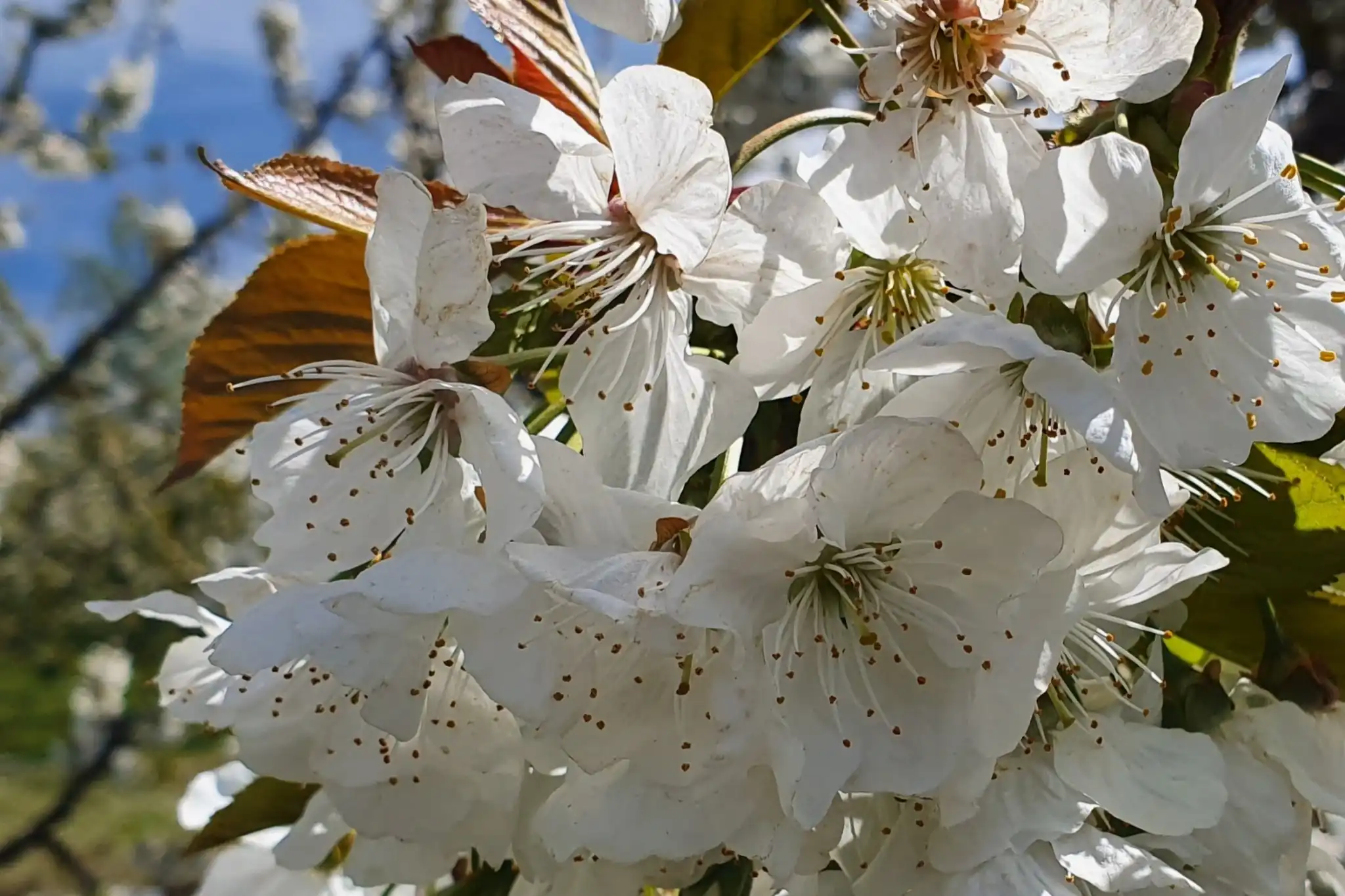 Fonte: Stefano Lugli
Flowering synchrony and compatibility
In particular, the study analyses how flowering synchrony and genetic compatibility among cultivars are crucial factors, often overlooked in orchard design, yet capable of strongly influencing pollination success and final production.
Through a combination of field trials and experiments under controlled conditions conducted in one of Portugal’s main cherry-growing regions, the researchers showed that the full-flowering periods of different cultivars display high variability and that their actual overlap can differ significantly from what is reported in the literature.
This aspect is particularly important, as it demonstrates that general recommendations provided by varietal catalogues or studies carried out in other pedoclimatic contexts are not always transferable at the local scale.
Flowering phenology therefore emerges as a dynamic variable, influenced by specific environmental conditions, which must be directly assessed in the production areas of interest.
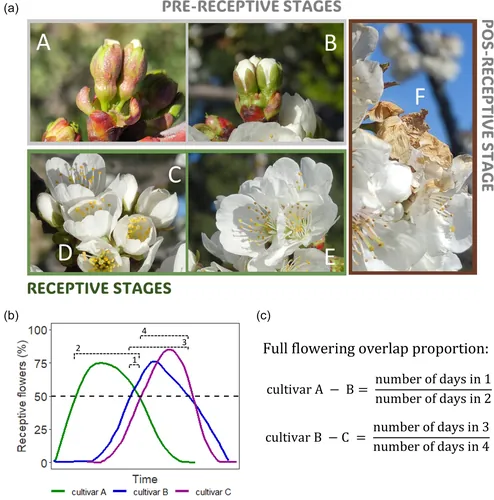
Figure 1. (a) Phenological stages of sweet cherry floral structures: first white flower (stage A), white bud (stage B), closed bud (stage C), open bud (stage D), open flower (stage E). Stages D and E represent the reproductive stages when flowers are receptive to pollen. Stage F represents corolla wilting. (b) Graphical representation of the percentage of receptive flowers per cultivar over time, indicating the intervals used in the example presented in (c). (c) Example of how the proportion of overlap in full bloom between recipient and donor cultivars (e.g., cultivars A–B) was calculated. Source: Choi et al., 2026
The study also examines cultivar compatibility, evaluated not only on the basis of S-allele composition but also through direct observation of pollen tube growth.
This approach makes it possible to overcome the limitations associated with using fruit set alone as an indicator of reproductive success, a parameter that is notoriously low in sweet cherry and strongly influenced by post-pollination factors.
The results show that crosses between fully compatible cultivars and semi-compatible ones, which share a single S-allele, lead to comparable levels of pollen tube growth and fruit set, suggesting that these latter combinations can also be productive.
This significantly expands the range of varietal pairings that can potentially be used in orchard design.
Implications for orchard management
The study highlights a marked level of pollen limitation in all the cultivars analysed, with natural pollination levels often insufficient to ensure optimal fertilisation of ovules.
This finding shows that the mere presence of pollinators does not always guarantee effective pollination, especially in orchards where the availability of compatible pollen is reduced due to suboptimal cultivar choice or poor flowering overlap.
By integrating data on compatibility and flowering synchrony, the researchers propose a cultivar suitability index that allows the effectiveness of different cultivar combinations as pollen donors and recipients to be quantitatively assessed.
Conclusions and future directions
In conclusion, the study suggests a shift in management strategies for optimising pollination in sweet cherry.
Flowering phenology and cultivar compatibility should be considered central elements in orchard design and management, alongside pollinator management.
Adopting this integrated approach represents a strategic tool to reduce yield gaps, increase orchard efficiency, and make cherry production more resilient to environmental and climatic variability.
Source: Siopa, C., Loureiro, J., Gaspar, H., Lopes, S., & Castro, S. (2026). Flowering synchrony and cultivar compatibility as key factors for optimising sweet cherry pollination and production. Annals of Applied Biology, 188(1), 229-245. https://doi.org/10.1111/aab.70044
Opening image source: Stefano Lugli
Andrea Giovannini
PhD in Agricultural, Environmental and Food Science and Technology - Arboriculture and Fruitculture, University of Bologna, IT
Cherry Times - All rights reserved