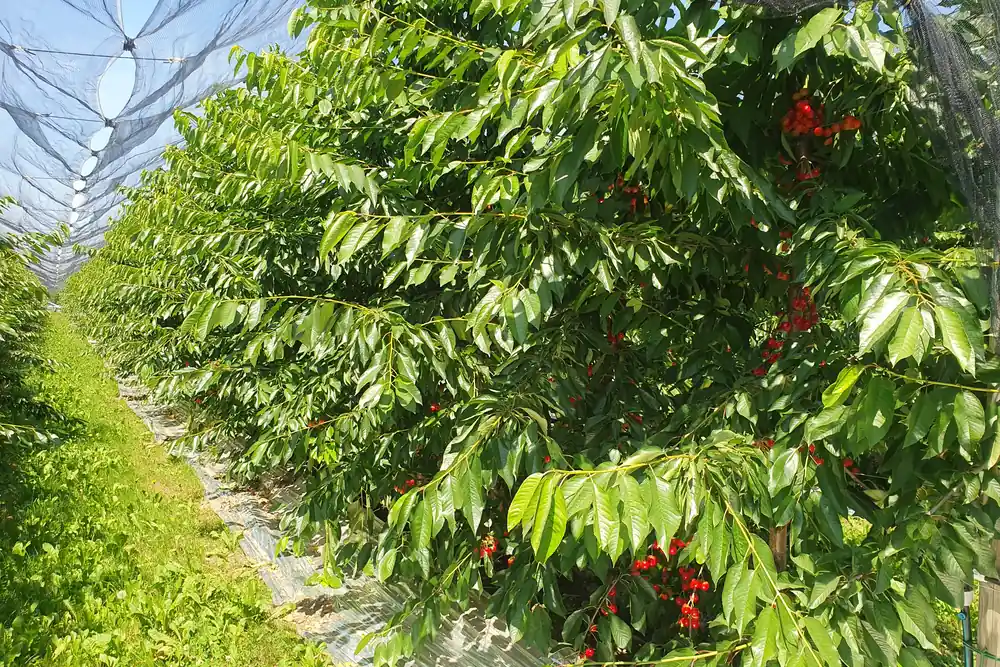
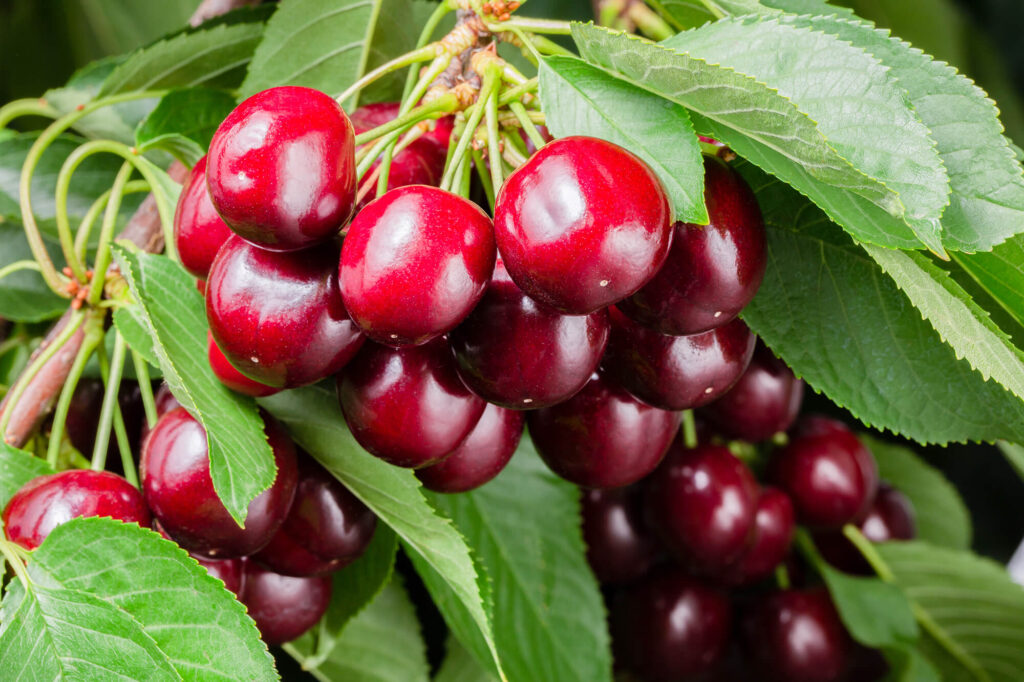
The technical director of Agromillora, Ignasi Iglesias, explains to Valencia Fruits the adaptability of the Corette® rootstock series to Mediterranean soils and its potential for more efficient, profitable, and sustainable intensive orchards.
Cherry cultivation has established itself as one of the highest value-added fruit crops in Spain, but also as one of the most demanding from a technical, agronomic, and commercial standpoint. With a current area of nearly 29,000 hectares and an average annual production of 121,000 tonnes, Spain is the leading exporter in the European Union and, among all fruits, cherries are the only ones showing a consistently growing consumption trend since 1989.
In a context marked by climate change and increasing market and distribution demands, the sector faces the constant challenge of evolving to maintain productivity, fruit quality, and farm profitability, with innovation as the guiding axis for the future of the crop.
The three pillars
According to Ignasi Iglesias, agronomist and technical director of Agromillora, innovation in cherry cultivation is based on three key pillars: varieties, rootstocks, and training systems, which must lead to optimal and high-quality production. “On the varietal front, there is significant innovation, with mid-chilling and low-chilling materials, as well as newer late selections that allow the harvest calendar to be extended, especially at higher altitudes.
Regarding rootstocks, the goal is to ensure the desired vigor, compatibility with varieties, adaptability to soil conditions, resistance to diseases, and tolerance to the effects of climate change — particularly high summer temperatures and reduced winter chill — while also guaranteeing good productivity. Finally, training systems take into account the vigor imparted to the variety, planting density, and tree architecture.”
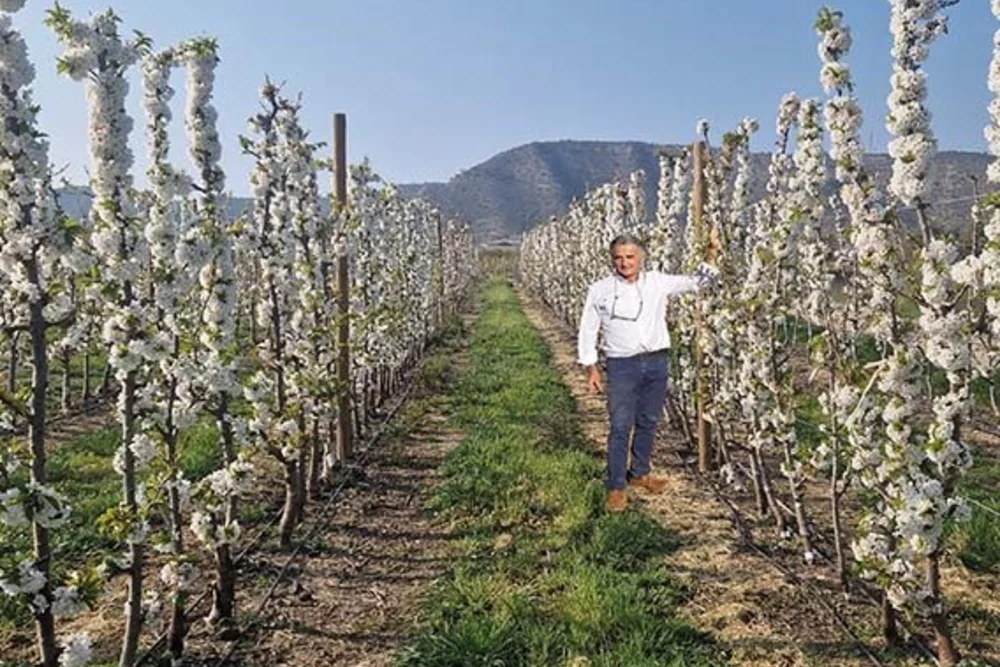
In this regard, Iglesias highlights that in all fruit species there is a trend toward intensification, with smaller trees and flat, two-dimensional or wall-based systems (single axis, bi-axis, or tri-axis), to improve labor efficiency in pruning, thinning, and harvesting operations, facilitate mechanization, and reduce production costs, particularly harvesting costs, which account for 60% of the total.
According to Iglesias, these three elements represent the technical evolution of the crop: “This is where innovation in cherry cultivation is concentrated, because there is no alternative: which variety to choose, which rootstock to use, and, based on this combination, which tree structure to adopt to make it accessible to both people and machines. Every aspect is continuously evolving.” Added to this are advances in digitalization, soil, plant and climate monitoring, and robotics.
The Corette® series gains prominence
In the field of rootstocks, Iglesias acknowledges that innovation has so far been rather limited given the specific soil and climatic conditions: generally calcareous soils and high summer temperatures, but notes that new solutions are emerging.
Among these, he mentions established series such as GiSelA®, particularly GiSelA®5 and GiSelA®6, widely used in Northern Europe, Northern Italy, and Chile. “These rootstocks reduce vigor, allow for more intensive orchards, enter production quickly, ensure high yields with good fruit size, and enable mechanization of operations such as pruning, thinning, and harvesting.”
However, these rootstocks
However, these rootstocks are not well suited to the Mediterranean areas of Spain characterized by warm climates, calcareous soils, and alkaline pH, which differ significantly from conditions in Northern Europe or Chile.”
To overcome these limitations, Agromillora developed the Corette® series, consisting of five rootstocks: Cass, Clare, Clinton, Crawford, and Lake, obtained from Michigan State University from species originating from biodiversity centers in Europe and Russia.
These rootstocks show lower vigor compared to SL-64 and Adara (reference rootstocks in Spain) and also compared to GiSelA®6.
Rootstock adaptability
This is a relatively recent series selected between 2000 and 2010. “An experimental license allowed Agromillora to introduce and propagate it to establish trial orchards between 2022 and 2025 together with other GiSelA® rootstocks,” explains Iglesias.
The experimental network, coordinated by Agromillora and CDB, aims to evaluate the adaptability of rootstocks to the soil and climatic conditions of Spain and other European countries. Two levels of trials have been established:
first level from 2023 in Spain (Mequinenza, Albalate de Cinca, Valle del Jerte) and from 2025 in Italy (Vignola and Sammichele-Bari); second level from 2025 within the European EUFRIN network, involving 18 countries.
The three Spanish orchards
“The three Spanish orchards are now in their fourth year and show interesting results, with good adaptability of some rootstocks such as Clare and Crawford to warm Mediterranean climates, adequate vigor (except Clinton), early bearing, and yields that, in some combinations with the Sweet Aryana® variety, exceeded 11 t/ha in 2025, which did not occur with GiSelA®5 and 6.”
Despite this, Iglesias urges caution: it is still too early to draw definitive conclusions. We will continue monitoring until full tree maturity and collecting data across more locations, both in calcareous soils and warm climates and in more temperate conditions.
If results remain positive, the next step will be commercial development on an international scale, given the growing interest in these materials for intensive orchards. “Intensification means planting more trees per hectare, but also producing faster, with better quality and lower costs in the long term.”
Training systems and management
The final pillar of innovation lies in cherry training and management systems, which are essential to optimize production, mechanization, and harvesting efficiency.
“Tree shape is crucial because it directly affects harvesting efficiency and fruit access, while taller trees require ladders, which are now banned in some countries.”
Iglesias highlights the advantages of two-dimensional (2D) systems: harvesting productivity increased by 72% in UFO systems (multi-axis 2D) compared to traditional vase systems.
These systems allow for pedestrian or semi-pedestrian harvesting as well as mechanical pruning and thinning with equipment such as the “Darwin”.
Already widespread in apple and pear orchards, 2D systems are also gaining ground in cherry production, especially in intensive orchards, thanks to their greater efficiency and compatibility with future technologies such as sensors, yield prediction, and robotics.
Conclusion
Overall, innovation in Spanish cherry production is built on three fundamental complementary pillars:
adapted varieties, innovative Corette® rootstocks, and intensive two-dimensional training systems.
To this is added the need to adapt to the reduction in winter chill due to climate change.
According to Iglesias, these advances not only make it possible to adapt cherry cultivation to local conditions, but also lay the foundations for a more competitive, profitable, and sustainable production model in the near future.
Juilia Luz
Valencia Fruits
Source of opening image: Valencia Fruits
Cherry Times - All rights reserved